Silhouettes of People Carrying Luggage: A Designer's Asset
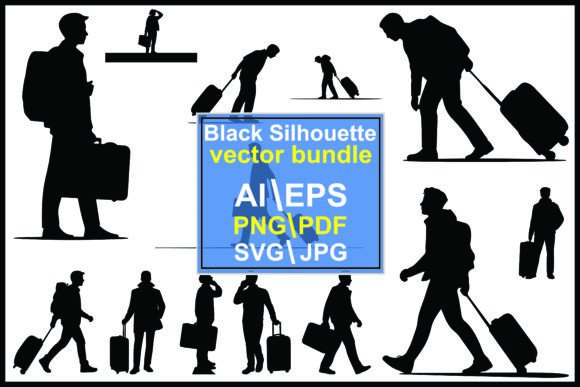
There’s an immediate, universal understanding when you see a silhouette of someone pulling a suitcase or hoisting a backpack. It speaks to movement, transition, and purpose without a single word. This collection of silhouettes of people carrying luggage isn’t just a set of outlines; it’s a visual language for travel, commute, and human journey. The figures are rendered in clean black and white, capturing various actions—walking briskly through an airport, standing patiently, or pulling a carry-on. This simplicity is its core strength. It strips away distracting details like clothing style or facial features, leaving pure, recognizable motion and form. For a designer, this is gold. It’s a versatile foundation that can adapt to countless projects while maintaining a cohesive, professional look.
More Than Just Shapes: The Psychology of Travel Silhouettes
Why do these specific silhouettes work so well? They tap into a collective visual shorthand. We instantly associate a person with a suitcase with travel, business trips, vacations, and the hustle of modern life. This makes the asset incredibly efficient for communication. In branding, using a silhouette from this collection can instantly convey themes of mobility, service, logistics, or adventure. The style is inherently neutral yet expressive. The black-and-white treatment ensures maximum contrast and flexibility, fitting seamlessly into both light and dark backgrounds. It avoids the pitfalls of trendy, overly detailed illustrations that can date a design quickly. Instead, it offers a timeless, graphic quality that leans into modern typography principles—where clarity and impact are paramount.
From a practical standpoint, the variety within the collection is crucial. You’re not getting one generic figure. You’re getting a curated set of poses and actions: someone pulling a wheeled bag, another carrying a backpack, figures in motion, and others standing. This allows you to create visual narratives. You can design a sequence showing a journey from departure to arrival, or build a scene with multiple travelers interacting with a space. This level of detail elevates a project from using a single clipart image to crafting a thoughtful visual story. It’s the difference between a generic stock photo and a custom illustration suite.
Practical Applications: Where These Assets Shine
The real value of a design asset is measured by its utility. Let’s break down where this silhouette collection becomes a go-to resource in your toolkit.
- Branding & Logo Design: For travel agencies, airlines, luggage brands, or tour operators, a stylized silhouette can form the cornerstone of a memorable logo. It’s a strong, recognizable mark that works at any scale, from a website favicon to a billboard. Paired with a clean sans serif font, it creates a modern, trustworthy identity.
- Marketing & Social Media Graphics: Need to advertise a travel sale, a new airport shuttle service, or a blog post about packing tips? These silhouettes provide instant thematic clarity. Use them as hero images, icons, or background elements. They integrate beautifully into social media graphics without overwhelming your message.
- Editorial & Web Design: In magazine layouts or website banners, these figures can guide the reader’s eye and add dynamic visual interest. They’re perfect for illustrating articles on business travel, commuting, or vacation planning. Their simplicity ensures they don’t compete with body text set in a serif font or script font, but rather complement it.
- Packaging & Environmental Graphics: Imagine retail packaging for travel accessories, or signage in an airport or train station. These silhouettes provide clear, language-agnostic wayfinding. They’re functional art that enhances user experience.
- Presentation & Business Materials: For consultants, logistics companies, or corporate trainers, incorporating these silhouettes into slide decks or reports can visually reinforce concepts like supply chain, employee relocation, or global operations in a sophisticated, professional manner.
Integrating Silhouettes Into Your Design Workflow
Having the asset is one thing; using it effectively is another. Here’s a strategic approach.
First, consider the visual hierarchy of your project. A large, bold silhouette can act as a focal point. Smaller, repeated figures can create patterns or borders that add rhythm and texture. Because they are outlines, they carry less visual weight than solid shapes, offering a delicate balance. This makes them excellent for layering over photography or complex backgrounds without causing visual clutter.
Second, think about font pairing. The clean, geometric nature of these silhouettes pairs exceptionally well with modern typefaces. A sturdy sans serif for headlines echoes their contemporary feel. For a touch of elegance in a travel brochure, a serif font for body copy can create a pleasing contrast. Avoid overly decorative script fonts or handwritten fonts for primary text, as they might clash with the silhouettes’ graphic simplicity. The goal is harmony, not competition.
Finally, always test for readability and context. If you’re using a silhouette as a background element behind text, ensure the contrast is sufficient. You might need to adjust the silhouette’s opacity or place a semi-transparent overlay between them. The included file formats—JPG, PNG, AI, EPS, SVG, PDF—are key here. The vector files (AI, EPS, SVG) allow you to scale the silhouettes infinitely without quality loss and easily change their color to match your brand identity palette. The SVG format is particularly useful for crisp web implementation.
This collection is a practical design asset for the working creative. It’s not about flashy trends; it’s about solving visual problems with a reliable, high-quality toolkit. Whether you’re crafting a brand identity, designing packaging, or building a website, having a library of such versatile, theme-specific graphics saves time and elevates the final product. It’s a small investment that pays dividends in professionalism and creative flexibility across your commercial and personal projects. The ability to use these designs for any purpose, as noted, removes licensing headaches, letting you focus purely on the creative work at hand.