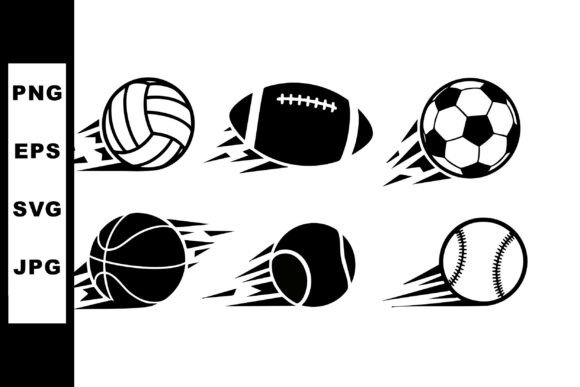
Six Flying Sports Balls Icons: Dynamic Energy for Design
A Visual Force of Motion and Energy
When a design project calls for immediate impact and a sense of unstoppable energy, static imagery often falls short. The Six Flying Sports Balls Icons set answers this need directly. This collection captures the essence of motion for six of the world's most popular sports: volleyball, football, soccer, basketball, tennis, and baseball. Each icon depicts its subject not at rest, but in mid-flight—a volleyball spiking, a football spiraling, a soccer ball curving, a basketball swishing, a tennis ball serving, and a baseball striking. Rendered in a bold, sporty style, these icons are designed to convey action, competition, and dynamic performance.
The visual personality of this icon set is unambiguous. It’s sporty and bold, prioritizing clarity and impact over intricate detail. The black colorway provides maximum contrast and versatility, allowing these assets to integrate into a wide spectrum of color palettes without visual conflict. The sense of motion is achieved through thoughtful line work and suggestive shapes, implying trajectory and speed. This isn't just a set of sports equipment; it's a collection of moments frozen in time, ideal for injecting vitality into any creative project. The downloadable package includes versatile SVG, EPS, JPG, and PNG files, ensuring compatibility with virtually any design software, from Adobe Illustrator to Canva.
Strategic Applications Across Industries
Understanding where to deploy these six flying sports balls icons is key to unlocking their full potential. Their strength lies in contexts where energy, competition, and athleticism are central themes. For brand identity work, particularly for gyms, sports teams, athletic apparel lines, or fitness influencers, these icons can become core visual elements. Imagine them animating a logo reveal, accenting a brand guidelines document, or forming the basis of a dynamic pattern for merchandise.
In marketing and advertising, their value is immediate. A social media campaign for a sporting goods store can use a flying basketball icon to highlight a sale, while a blog post about training techniques can be visually anchored by a tennis ball in motion. For editorial design and publishing, they serve as perfect spot illustrations in magazines, newsletters, or eBooks related to sports, wellness, or even business metaphors about competition and winning. The icons excel in web design as engaging section dividers, list markers for sports-related content, or interactive elements in a user interface. Even packaging design for energy drinks, protein bars, or sports equipment can benefit from this dynamic and energetic design language.
Beyond the Obvious: Creative and Commercial Uses
While the sports context is clear, the metaphorical power of these icons extends further. A marketing agency could use a flying soccer ball to represent "kicking off" a new campaign. A financial advisor might use a baseball icon to discuss "hitting it out of the park" with investments. This flexibility makes the set a valuable design asset for entrepreneurs and content creators who need to communicate ideas of motion, progress, and achievement. The provided file formats—SVG and EPS for scalable vector work, JPG for quick web use, and PNG for transparent overlays—make this a practical toolkit for both digital and print projects, from website graphics to printed flyers and apparel.
Integrating Icons into Your Design Workflow
Successfully incorporating a premium font or icon set into a project requires more than just placing it on the canvas. With the Six Flying Sports Balls Icons, consider the principle of visual hierarchy. These are inherently high-impact elements. Use them as focal points or supporting accents, not as background noise. Their bold nature pairs exceptionally well with clean, sans-serif typefaces for body text, creating a balanced composition where the icons provide the energy and the text provides the clarity.
Evaluate project fit by asking: Does the core message involve movement, competition, sport, or achievement? If yes, these icons are likely a strong candidate. When testing font pairings, if you’re using these alongside typography, opt for fonts with a modern, confident aesthetic. A sans serif font with good weight often complements the icons' boldness without competing for attention. Avoid overly ornate script fonts or delicate serif fonts unless the contrast is an intentional and strategic part of your design narrative.
From a practical standpoint, review the included styles. The consistent black color ensures unity across the set, but you can easily recolor them in your software to match a specific brand palette. Always test for readability in context—an icon used as a bullet point should be clear at a small size, while one used as a hero graphic can embrace its detailed motion. For any commercial font or asset, always verify the licensing. The ZIP file's inclusion of multiple formats typically indicates a broad license suitable for personal and commercial projects, but reviewing the specific terms is a professional best practice. By thoughtfully applying these icons, you leverage a creative font asset that does more than decorate—it communicates motion, passion, and results.